Posts by Rabbi Mara Young

Friday, September 27, 2024

Nitzavim in Elul

Call it Moses’ last stand. In parshat Nitzavim, Moses reminds Israel of the covenant they forged with God. It’s not just one community connecting to one God, though, but an affirmation of each individual’s relationship to the Divine and Divine law.

It begins with, “You stand this day, all of you, before your God יהוה —your tribal heads, your elders, and your officials, every householder in Israel, your children, your wives, even the stranger within your camp, from woodchopper to waterdrawer—to enter into the covenant of your God יהוה, which your God יהוה is concluding with you this day, with its sanctions”


In this list, Moses moves down the social hierarchy in order of social influence. Up top: Tribal heads, elders, officials, householders (that’s free men!), their children, their wives, then the strangers (those are the non-Jews who have come along for the desert journey).


Ranking in at the bottom: woodchoppers and waterdrawers. Based on knowledge of social roles in the ancient near east, biblical scholars agree that the woodchoppers were likely the male servants and the waterdrawers were the female ones.


Moses’ descending order is a hermaneutical tool. While it acknowledges the stratification of power, it ultimately delivers a message of equality. Everyone, no matter where they appear on the pyramid, has direct access to God and just as much obligation when it comes to fulfilling God’s commandments.


Reading this in the month of Elul, the month leading up the High Holy Days, drives home the feeling of intimacy that these days aim to evoke. The Lubuvacher rebbe, drawing on rabbinic tradition, explains that “the king's usual place is in the capital city, in the royal palace. Anyone wishing to approach the king must go through the appropriate channels in the palace bureaucracy and gain the approval of a succession of secretaries and ministers. He must journey to the capital and pass through the many gates, corridors and antechambers that lead to the throne room. His presentation must be meticulously prepared, and he must adhere to an exacting code of dress, speech and mannerism upon entering into the royal presence.


However, there are times when the king comes out to the fields outside the city. At such times, anyone can approach him; the king receives them all with a smiling face and a radiant countenance. The peasant behind his plow has access to the king in a manner unavailable to the highest ranking minister in the royal court when the king is in the palace. The month of Elul, says Rabbi Schneur Zalman, is when the king is in the field.”


Everyone matters and everyone has access, no matter how big or small, no matter their station in our community or our society.


There is one other way to look at woodchoppers and waterdrawers that I want to give to you as a pre-Rosh HaShanah gift.


Rabbi Bradley Artson offers some metaphors for how to read “woodcutter” and “waterdrawer” in the coming year. It has to do with how we treat others:


Woodcutters: I understand this term to be a metaphor for possible abuse in interpersonal relationships. How often do we see the person across from us, or beside us, as an object to cut down, prove wrong, or shape in the image we think they ought to be? This can happen within our families, synagogues and temples and places of business. Instead of chipping away at the edges to see what is truly beneath a person's exterior, we (often by accident) cut too much, creating scraps that are difficult to reassemble.


This pertains to our relationship with God as well. While our illustrious tradition certainly demands that we question (with passion!) God and other spiritual matters, do we sometimes go too far? Is it possible to dig so deep into that relationship and expect so much from that relationship, so that when no immediate gratification arrives, the relationship is tarnished?


Water Drawers: I understand this designation to be a metaphor for how we can see others as wells of inspiration, waiting for us to engage them, learn from them, be nourished and satiated by them, and to ultimately compliment one another. This suggests that our relationships go two ways. We give, and we receive (and the two are not always equal). There are limits, though. A well can dry up if one draws too much without replenishing it, offering something in return. But finding that balance is not so simple.


He asks us to consider: when are we woodchoppers? When are we water drawers? Each are actually quite powerful. In the coming year, we should be mindful of how we wield our axes and our buckets.


No matter the approach you take to this week’s Torah portion, the steady theme seems to be how powerful each of us is.


Elul, and soon enough, the High Holy Days, will propel us into 5785 with a sense of agency as well as accountability.


As we approach this sacred time, and perhaps the sacred presence of God that resides within it, may we be mindful of our words, constructive in our actions, and empowered to know the holiness already in our midst: it resides in our own hearts and minds and in those of our neighbors.


Ken y’hi ratzon.

Friday, September 6, 2024

Hersh

With all the horror going on in Israel, Gaza, and the West Bank, why did this week hurt more than other weeks?

Perhaps it was the truly dramatic tragedy of the thing: that the six young Israelis, stuffed away in a terror tunnel, were murdered just 48 hrs before they could be rescued. Perhaps it is the maniacal heinousness of Hamas. Perhaps it is the obstinate guilt of Netanyahu. Maybe it’s the fact that these six lives, and the tens of thousands that have perished these last 10 months, are all pawns in a twisted game that has barrelled out of control. The helplessness has hit a new low.

I stand with the thousands of Israelis imploring their government to strike a deal. Bring them home now. Save the lives of the hostages, the innocent Palestinians, the IDF soldiers and all those who just want to be home, safe, in the arms of their families.

This week, Rachel Goldberg-Polin, Hersh’s mom, eulogized her son. In the political hotbed of war, she stood before the world as a mom who wanted to hug her son again.

“It is not that Hersh was perfect,” she said, “But, he was the perfect son for me. And I am so grateful to G-d, and I want to do hakarat hatov and thank G-d right now, for giving me this magnificent present of my Hersh…For 23 years I was privileged to have this most stunning treasure, to be Hersh’s Mama. I’ll take it and say thank you. I just wish it had been for longer.”

I was astounded by her ability to even utter the word “gratitude” in such a thankless, heartbreaking circumstance when the world had failed her.

Listening to her speech while meditating over the faces of the six murdered young people, I saw the thousands of others behind them - the faces of all the children whose lives have been ended by this abhorrent violence. I saw their mothers’ tears in Rachel Goldberg-Polin’s eyes. I felt their mothers’ cries in my own lungs.

2000 years ago, the prophet Jeremiah invoked another mother-Rachel’s tears. As he surveyed the destruction of Jerusalem, in chapter 31 of his prophesy, Jeremiah cried, “A voice is heard, lamentation and bitter weeping: Rachel is weeping for her children and refuses to be comforted for her children, because they are gone.” (Jeremiah 31:15).

Jeremiah and our sages consider Rachel imaneu - our foremother Rachel, wife of Jacob - to be the personification of a weeping Israel; a mother who suffers as her children have been carted off into enemy territory and whose lives have been shattered.

Jeremiah continues: “And God will answer her: Restrain your voice from weeping, and your eyes from tears; for your work will be rewarded, says God, and they will return from the land of the enemy. There is hope for your future…that your children will return to their own borders.’”

How are we to read this part of Jeremiah’s prophecy? Your work will be rewarded, they will return to their own borders. Rachel Goldberg-Polin has spent a year using her every waking moment to bring her son home and for nothing.

Can we read Jeremiah’s words with any credibility? If I’m being generous, they can give us hope. But I’m not feeling generous. I’m feeling betrayed. These days it feels like insisting on hope is to insist on vapor - empty wisps of human goodness that seem to flee every time we grab at them.

So sometimes we need to look elsewhere for inspiration.

My colleague Rabbi Josh Whinston wrote that he heard Rachel Goldberg-Polin speak this summer: “She said that when Hersh left for the Nova festival, he left his copy of The Art of Happiness by the Dalai Lama at home since he only expected to be gone for a night or two. He was on the sixth chapter.”

Rabbi Whinston suggested we finish reading it in his honor. Perhaps you would like to take up the suggestion. I got a copy and began to look it over:

In Chapter 5, words Hersh had just read, the Dalai Lama shares:

Sometimes when I meet old friends, it reminds me how quickly time passes. And it makes me wonder if we've utilized our time properly or not. Proper utilization of time is so important. While we have this body, and especially this amazing human brain, I think every minute is something precious. Our day-to-day existence is very much alive with hope, although there is no guarantee of our future. There is no guarantee that tomorrow at this time we will be here. But we are working for that purely on the basis of hope. So, we need to make the best use of our time.”

In other words, hope gives us purpose. Cherishing life means knowing it might end, and while we may want to ignore that fact, it is the key to finding meaning.

The Dalai Lama then anticipates our question: how do we make the best use of our time? He continues: “I believe that the proper utilization of time is this: if you can, serve other people, other sentient beings. If not, at least refrain from harming them. I think that is the whole basis of my philosophy.”

It seems basic enough. And yet we’re failing at the “refrain from harm” part. To even put it that way is a depressing understatement.

But in honor of Hersh, we’ll trudge forward into Chapter 6. Given our drive to harm one another, how do we begin to curb our brutal inclinations?

The Dalai Lama answers: “Love and compassion are necessities, not luxuries. Without them, humanity cannot survive.”

Love and compassion are necessities, not luxuries. We must insist upon love, even creating it from the chaotic ugliness of loss. Rachel Goldberg-Polin taught this as she addressed Hersh’s spirit: “As we transform our hope into grief and this new unknown brand of pain, I beg of you, please do what you can to have your light shine down on me, Dada, Leebie and Orly. Help shower us with healing and resilience. Help us to rise again. I know it will take a long time, but please may G-d bless us that one day, one fine day, Dada, Leebie, Orly and I will hear laughter, and we will turn around and see… that it’s us. And that we are ok. You will always be with us as a force of love and vitality, you will become our superpower.”

I am so grateful for these words. The darkness of this war has shaken us down to the depths of our souls. But can we acknowledge that we are feeling so deeply sad because we love, because we are capable of compassion? To see a world where love and compassion are lacking damages our hearts. So to survive, we must insist upon them. Like Rachel, our grief will represent our love and that will be our superpower.

This is what I see in the Israelis who have taken to the streets and continue to advocate on behalf of the hostages. Yes, it is anger, but it is also love. Love of their fellow citizens, love of their country. Love of all humanity.

Love is where it all begins and ends, at least according to Jeremiah. Because chapter 31:3 also states: “With everlasting love - a love from the beginning of the world - I have loved you.”

May we find the courage to love with an everlasting love, forged from the foundations, with the power to shatter hate. May we express gratitude, even when the word feels foreign, and may we insist on reuniting as many loved ones as possible, helping to dry the tears of every Rachel, to finally end the suffering.

Sunday, August 4, 2024

Dog Days of Summer

In the Northern Hemisphere, July and August are particularly hot and humid. The Old Farmer’s Almanac calls these days “the Dog Days of Summer.” Why “dog” days? I always thought it had something to do with how we start to pant like dogs in the sun, but turns out it has to do with the star Sirius and its connected constellation - the dog.

Sirius is the brightest star in the sky this time of year - a time of extreme weather patterns that impact a harvest’s yield. Throughout history, people have understood the star’s rising as ominous - signaling storms, drought, and other dangers. The Old Farmer’s Almanac warns:

Dog Days bright and clear
Indicate a happy year;
But when accompanied by rain,
For better times, our hopes are vain.


While the lilt is light, these are words of warning and worry. They’re filled with vulnerability and the memory of knowing hunger and hardship in prior seasons.

Judaism has its own form of “dog days,” as well as a poetic expression of our suffering. We’re in the dog days of the Jewish calendar right now: the 17th of Tammuz through the 9th of Av. The 17th of Tammuz (last Tues, July 23) remembers the breach of Jerusalem’s walls just before the destruction of the Second Temple in 70 CE. These three weeks are known as “bein hametzarim,” within the narrow straits.

For the next three weeks, here in the heat of the summer, we pace the hot sands of grief, culminating in the 9th of Av, the day of destruction. It is the day that mourns the ravage of Jerusalem with the fire of war and hate, culminating in the ruin of both its temples (in 586 BCE and 70 CE, respectively).

On Tisha b’Av, we read the Book of Lamentations, our scroll of memory and anguish:

From above [came] a fire
Down into my bones…
[God] has left me forlorn,
In constant misery… (Lamentations 1:13)


Tisha b’Av has come to mourn all the calamities that have befallen our people over time and space. That said, it is most deeply rooted in one geographical location - Jerusalem and the Land of Israel.

Lamentations often speaks from the perspective of Zion, the birthplace of our people and the cradle of many civilizations. She is the contested homeland for her many children and their fighting has rendered her battered and destitute. The poet is explicit about the impact of this violence against her:

Zion spreads out her hands,
She has no one to comfort her…
Jerusalem has become among them
A thing unclean. (Lamentations 1:17)


Lamentations expresses isolation and abandonment. It wonders if God has left forever. It looks around at the destruction and wonders if it is possible to survive all the pain.

How real these ancient words feel to the modern ear! It has been nearly a year's worth of raining fire, smoldering ruins, and death. Israeli hostages are still locked away in torture.

My eyes are spent with tears,
My heart is in tumult,
My being melts
Over the ruin of my poor people,
As babes and sucklings languish
In the squares of the city. (Lamentations 2:11)


Could it be that the ancient poet wrote this about the children of Gaza who have had their childhoods stolen by leaders who would use them as pawns in a twisted game?

How real it sounds when we call to mind the Israeli children of Majdal Shams and their broken bodies scattered over the soccer pitch!

It has been nearly a year of anguish, and yet in these dog days of summer, the heat of the mideast reality has multiplied tenfold. Like the writer of Lamentations, I could continue my litany of woes and worries - especially given the threat of all-out war with Iran and the reports of abuse in an Israeli detention center.

These 3 weeks are indeed “bein hametzarim,” within the narrow straits. We are pressed tight by grief and guilt. And even though we know this is a shared feeling, when the walls are this narrow, we inevitably feel cut off from others, alone in our grief.

I am here to tell you that you are not alone in this pain. I cannot alleviate it, but I can assure you that you are not alone. I am also not sure of what hope I can provide, but I can send you to people and organizations doing hard work not to lose hope. I’ll mention some in just a bit.

I can also point out that it is not a coincidence that on the other side of these three weeks we start to head into Elul and the High Holy Day season. Just beyond that we meet the rainy season, when rain quenches the parched fields of Israel and our hearts. It is a season of reflection, repentance, and determination and it’s just on the other side of this narrow place.

Visualize a shofar - narrow at one end, wide open at the other. Rabbi Margie Jacobs, inspired by hasidic sources, finds significance in this: “The shofar is narrow [at the bottom] and wide [at the top]. You have to blow specifically from the narrow place. If you blow from the wide part, nothing will come out. [This release from the narrow place] is the voice of truth…as it is written [in Psalm 118,] “from the narrow place I have called to [the Eternal] and have been answered in spaciousness.”

These dog days, these three weeks of what feels like impending doom, are met every year with a cry out into the expanse. Yes, it is a call of desperation, yet it is also a call to possibility. It is a call out to hope.

After the first destruction of Jerusalem, the prophet Jeremiah wrote to the priests, prophets, elders, and populace of the exiled Jewish community. They were helpless, hopeless and on the brink of annihilation as a people. He encouraged them: “Build houses and live in them, plant gardens and eat their fruit. Build families and increase the generations…seek the welfare of the place where you find yourself, for in its prosperity, you will prosper” (Jeremiah 29: 5-8).

His message is simple: in the face of destruction, be a builder. In the blistering heat of a world on fire, channel your grief into constructive action.

I suggest getting involved with ARZA and the IMPJ - progressive, Zionist voices speaking out for a democratic, compassionate Israel and an end to this war. Send your support to organizations that promote a shared society in Israel like the Hand in Hand School Network and others.

Remember, the shofar's narrow end, the place of our deepest pain, is also where our most profound transformation begins.

הֲשִׁיבֵ֨נוּ יְהֹוָ֤ה ׀ אֵלֶ֙יךָ֙ וְֽנָשׁ֔וּבָה חַדֵּ֥שׁ יָמֵ֖ינוּ כְּקֶֽדֶם׃

Take us back, O Eternal, to Yourself,
And let us come back; Renew our days as of old! (Lamentations 5:21)


May we merit a return to this place of bounty and goodness. May we renew our pledge of peace and begin to live in Oneness with you, Eternal God, as in days of old. Amen.

Friday, June 21, 2024

Waiting and Changing - Juneteenth

I recently read a piece by Tali Puterman, the director of Racial Equity, Diversity, Inclusion and Justice Organizing at Temple Israel in Boston. For Puterman, Juneteenth’s proximity to the Jewish holiday of Shavuot is thematically significant. Seven weeks after the exodus from slavery, Shavuot honors the transmission of Torah - all its laws and morals - at Mt. Sinai. Juneteenth also commemorates emancipation from slavery and the anticipation of full rights and recognition. And yet she shares these vignettes from her imagination, which also represent those watershed moments:

An impatient Israelite stands at Mount Sinai, waiting for the overdue arrival of Moses and the promise of a new way of life.

An enslaved person sighs with frustration. Years after the Emancipation Proclamation, the law is not enforced.

A modern Black American is angered that even now - hundreds of years after a promise of freedom - she experiences systemic racism in the only country her family has known for generations.


These three vignettes are separated by hundreds, if not thousands of years, and yet they are linked in experience. The ancient Israelites were newly freed from slavery, waiting for their new life at the base of Sinai with anticipation. And yet, what was taking so long? Where was the proof of their covenant with God? Was it all a dream? Had God abandoned them in the wilderness? Would God really continue to guarantee their well-being and prosperity?

Similarly, Juneteenth celebrates emancipation, but highlights the gap between the Emancipation Proclamation and when the law was implemented.

Cut forward to today, we know that Black people in America still await the realization of true freedom and a covenant with our country that ensures safety and prosperity for all. In many ways, we remain in the wilderness.

Puterman shares that Dr. Leah Ben-Ami inspired these thoughts: “Dr. Ben-Ami shared the significance of celebrating these holidays. She expressed that, due to living in a society that privileges certain historic narratives over others, it was not until later in life that she became aware of Juneteenth. She wondered how her enslaved ancestors heard the news of their freedom and compared it to the experience of the Israelites at Mount Sinai as they were waiting to receive the Torah.”

I think it is important to highlight Dr. Ben-Ami’s point that we live in a society that privileges certain historic narratives over others. It has been a long haul for Black Americans to have their story told - how our country was built on the backs of their ancestors. It has been a long haul, we have made progress, and we have more work to do.

Juneteenth reminds us, even mandates us, to tell the stories. It’s a crucial federal holiday for this reason. I knew nothing of Juneteenth as a child. As I look back on my knowledge of the Civil War and slavery, it is a woefully reductive story. But ask Noah and Asher and they can both give you an articulate, well-informed primer on Juneteenth, including the fact that there was a gap between the Emancipation Proclamation and when enslaved people knew their status had changed or could do anything about it. They will also tell you that the end of slavery was not the end of their struggle.

They know from me and Mark, and they know from school, that racism still pervades our society. We make a concerted effort in our home to teach about white privilege and what they can do to be part of restorative solutions. We also teach them about anti-semitism and the ways it is similar to and different from racism.

Is it easy to have these conversations with an 11 and 8 year old? No.

Is it taking too long for the dream to become reality? Yes.

And despite the discomfort and frustration, each generation is obligated to listen to the stories they’ve been told, dig up the ones that weren’t shared, and pass forward as much Torah as they can to bring us closer to the dream God has for us.

As Rabbi Tarfon famously said: “It is not your duty to finish the work, but neither are you at liberty to neglect it.” Translated literally: you are NOT FREE to neglect the work of justice. We abolish slavery because the only chain that binds us is the moral connection between us and the rest of God’s creation. You are free to do everything except ignore your moral responsibilities to others.

Also, did you know there’s more attached to Rabbi Tarfon’s famous saying? The quote is much longer than “It is not your duty to finish the work, but neither are you at liberty to neglect it.”

It continues…first with, “If you have studied much Torah, you shall be given much reward.” I interpret this as, “the more we discover our history and our values, the more we will thrive as a society.”

Then: “Faithful is your employer to pay you the reward of your labor…” Our God does not enslave us, our God sets us free and compensates us for our hard work!

And then concludes: “...And know that the reward given to the righteous is in the age to come.” That is, true freedom may still be ahead of us, but we need not wait quietly for it to come.

“It is not your duty to finish the work, but neither are you at liberty to neglect it; If you have studied much Torah, you shall be given much reward. Faithful is your employer to pay you the reward of your labor; And know that the reward given to the righteous is in the age to come.”

L’dor vador, from generation to generation, indeed.

Friday, May 31, 2024

The Universe is Humming

Did you know that “the whole universe is humming?” That’s how Atlantic writer Adam Frank describes a recent scientific breakthrough. According to Frank, hard data now proves that, “Every star, every planet, every continent, every building, every person is vibrating along to the slow cosmic beat…a background of gravitational waves [are] washing through the universe, the space-time equivalent of car horns, jackhammers, and shouts all combining into the diffuse cacophony of city life.”

What’s the source of this universal heartbeat? According to the experts, the source may be “the zillions of supermassive black holes, some billions of times heavier than the sun, that reside at the center of every galaxy. Over cosmic timescales, galaxies collide and merge—and so do their black holes. These are near-apocalyptic events in terms of their effect on space-time, like a wall of speakers at a heavy-metal concert blasting against so many eardrums. Untold numbers of galaxies have merged across the 13.8-billion-year life of the universe, and those blasts should still be echoing in the background of space-time today. And so, perhaps, should the gravitational waves from the birth of the universe itself. The Big Bang was, well, a big bang. Initiating the expansion of everything required so much energy, and did so much violence, that it should have flooded space-time with gravitational waves that continue to ricochet around the universe to this day.”

Scientists found that “Every gravitational wave in that background…is humming through the very constitution of the space you inhabit right now. Every proton and neutron in every atom from the tip of your toes to the top of your head is shifting, shuttling, and vibrating in a collective purr within which the entire history of the universe is implicated.”

If you’re looking for a succinct description of what I think “God” is, it’s in that description. I don’t believe in a God who is pulling at invisible strings a living puppet performance. Instead, I understand God as a connective force, a uniting essence that connects the dots between all organisms and the inanimate world we inhabit. I believe God is the pulsing heartbeat that syncs them together.

This scientific discovery that Frank describes makes me feel so small and insignificant but also infinitely connected at the same time.

Scientifically, what do we gain with this insight? Nothing tangible, really, but perhaps something transformational instead.

Frank continues in his article: “The gravitational-wave background is huge news for the cosmos, yes, but it’s also huge news for you. The nature of reality has not changed—you will not suddenly be able to detect vibrations in your morning coffee that you couldn’t see before. And yet, moments like these can and should change how each of us sees our world. All of a sudden, we know that we are humming in tune with the entire universe, that each of us contains the signature of everything that has ever been. It’s all within us, around us, pushing us to and fro as we hurtle through the cosmos.”

Knowing this cosmic connectedness (or we may say, perceiving of God in this way) should give us a sense of wonder and awe that helps bring more meaning to life. It helps to articulate its sanctity. It might drive us to care for our mental and physical health more or to care for the earth with more gusto. It reminds us that we are not separate, inconsequential entities, but rather integral parts of the universes’ fabric. It forces us out of isolation or being self-absorbed.

I also wonder if it acts as a blueprint for how to think about “cataclysmic events” here on earth. When I think about violent cosmic events, I tend to think less about deep space and more about the mid-east. Instead of distant galaxies I’m watching local courtrooms and verdicts.

But what makes these earthly events different from those of the cosmos is how much control we have over them. We cannot change or even perceive the ways the universe’s processes reverberate through us and our lives - all we can do is marvel at it. But refugees, hostages and political corruption? As insurmountable as these problems seem sometimes, they are in fact a result of human choices and are therefore within humanity’s control.

But this fact does little to comfort us. Realizing just how responsible and culpable we all are, we fall fast, like a heavy meteor, from a state of awe to a barren of despair and hopelessness. We feel out of sync, disappointed in ourselves, with the future feeling bleak.

These themes - the easy shift from awe to desperation and contemplating how much control we have in the greater fabric of nature - lie at the heart of this week’s Torah portion, Bechukotai.

God states plainly: If you follow my commandments, I will make the rain come. You’ll have a good harvest, you’ll eat well, you’ll thrive. If you don’t follow my commandments, I will scatter you and wreak misery on you, because you broke my covenant with you.

We struggle with this stark cause and effect. Can it really be that if I am good, if we are good, then all will be tranquil and abundant? We know that’s not the case. Either this is primitive thinking, OR it pre-assumes that we have and never will be “good” enough. It means this utopian, peaceful vision is just God’s imaging outloud. So then if that’s the case, we are left thinking, “what’s the point?”.

The key word in the Torah, though, is covenant. God is specific: it’s not just that we didn’t keep God’s laws and therefore we don’t get our allowance. Rather, by acting in violent and insolent ways, we have gone out-of-sync with the universe. Our negative actions jarringly disconnect us from God and we suffer the isolating consequences.

According to science, we can’t actually escape God or nature, it’s impacting us even when we can’t perceive it. But according to Torah, we can make an active choice to be a willing, nurturing part of it and therefore benefiting from a feeling of sanctity, awe and purpose. This is why we do acts of repair and call our work tikkun olam - fixing the world.

This is also why we pray. We sing and chant as a way of attuning ourselves to the universes’ pulse. It is the way we perceive God in our midst. With an affirmed sense of awe, we set out to prevent the cataclysmic collisions within our control. In the event that we can’t avoid it, we then at least have the strength to withstand what comes, knowing what is right in our hearts - placing preserving life and human connectedness as values above all else.

As the universal heartbeat resonates in our own bodies, may we find not only a sense of our own smallness but also the boundless connectivity that enfolds us. Let us marvel at the intricate dance of galaxies and the pulsing rhythm of life, knowing that within us resides the echoes of eternity. Let us embrace our role as stewards of creation, seeking harmony in our actions and compassion in our hearts. Amen.

Friday, May 17, 2024

Jewish Resilience

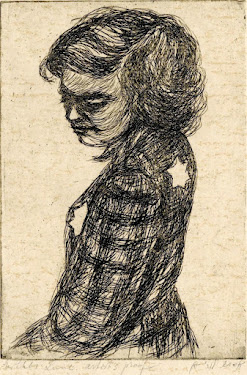
The drawing you are looking at is called Portrait of a Young Woman with Two Yellow Stars by Esther Lurie.

The Jewish Women’s Archive gives it some context: “Esther Lurie was an artist who sought to document the atrocities of the Holocaust and leave a testimony of the Jewish experience in the Kovno ghetto. The clandestine production and documentation of ghetto life was the artist’s way of struggling against murder and destruction, an act of spiritual resistance.

Esther Lurie was born in Liepāja, Latvia. In June 1941, with the German invasion of the Soviet Union, Lurie was arrested in Kovno, Lithuania while visiting her sister and deported to the Kovno ghetto.

In the fall of 1942, at the request of the Jewish leadership of the ghetto, Esther, together with other artists, began documenting life in the ghetto. Drawing supplies were hard to acquire; artists had to smuggle them from the workshops controlled by the Nazis. In Portrait of a Young Woman with Two Yellow Stars, the yellow badge is depicted as a hole that goes through the young woman, [like that] left by a gunshot wound when the bullet passes through [a] body.”

As I gazed at the drawing more, I thought about how despite her “wound,” the girl is very much alive. Perhaps the stars, meant to mark the bullet’s path, defy death. We Jews defy death. We survive when history would say it wasn’t possible.

It is impossible to know what happened to this young woman. Did she survive the liquidation of the ghetto? This drawing is either an early photograph in a child’s history or the portrait of a ghost.

Either way, it is a picture of a child. And the children are my concern tonight.

In this week’s Torah portion, God commands the people of Israel: "If anyone among the Israelites, or anyone among those who live with them in the land, gives their offspring to Molech, they should be punished by death." (Lev 20:1-2)

Some background to the Torah:

- It acknowledges that Jews and non-Jews will live in the Land of Canaan together.

- It prohibits, with disgust, the ancient practice of sacrificing one’s child to the false god Molech. This sacrifice was done, typically, by fire.

By these standards, all of humanity deserves punishment. In the very land the Torah speaks of, the number of children who have been taken hostage, burned, and bombed is unconscionable. They have been sacrificed to the false gods of war and extremism.

And the ones who are still alive? I weep for the trauma that will scar a generation of Israeli and Palestinian children. They are innocent. They deserve innocence. It’s right there in this week’s Torah portion.

Resilience. What does resilience look like in a moment like this?

Well, unsurprisingly, it comes from the children.

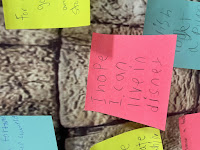
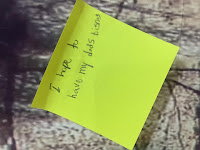
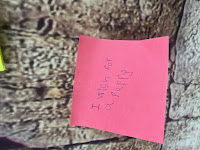
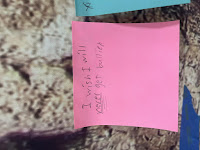
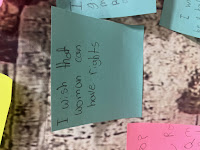
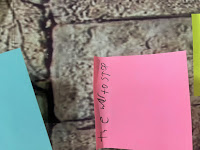
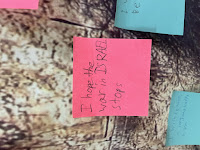
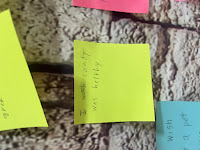
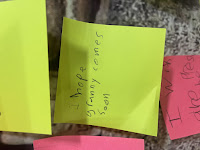
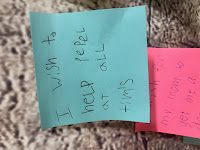
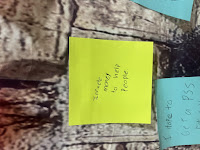
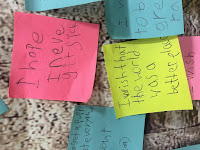
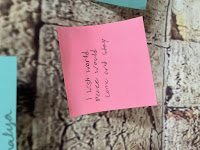
Back in April, Concord Road Elementary School - grades K through 4 - held its International Day. I, along with other WCT members and our friends, prepared and worked at the Israel booth. The concept was simple: write a wish on a Post-It note and place it on our giant Western Wall.


Many of the contributions were whimsical.

Some more poignant.


Predictably, war in the Middle East was on their minds.

We took a deep breath and accepted that there would be a variety of perspectives.


I find the post-its on the left to be particularly meaningful….two very different articulations of the same place…an encapsulation of this moment’s complexity….and there they are, side by side. 

But for the most part, the kids expressed the most honest yearnings of any human.


The words of these children are our prayer tonight.

We pray for innocence and joy. We pray for the reunion of parents with their children. We pray for safety and sweet dreams; for leaders who put the lives of their people first. We pray for thoughtful discourse and peaceful disagreement. We pray for connection and continuity.

We call upon the courage and determination of our ancestors, invoking the best of the moral path they laid for us and pray with our whole hearts for peace.

Sunday, April 21, 2024

Ha Lachma Anya - Shabbat HaGadol

 “Ha Lachma Anya! This is the bread of our affliction! This is the bread of affliction that our ancestors ate in the land of Egypt. All those who are hungry, let them enter and eat. All who are in need, let them come celebrate the Passover. Now we are here. Next year in the land of Israel. This year we are slaves. Next year we will be free!”


It’s a real invitation because in just a few haggadah sections we’ll literally break matzah and eat the festive meal, in theory, inviting others to join us in doing so.


The Association for Experiential Education understands experiential education as "a philosophy that informs many methodologies in which educators purposefully engage with learners in direct experience and focused reflection in order to increase knowledge, develop skills, clarify values, and develop people's capacity to contribute to their communities." The seder is certainly a Master Class in experiential education. 


Dr. Wendy Zierler, a professor at HUC also illuminates the impressive experiential pedagogy of the seder. The seder, according to Zierler, is an example of “liberatory education,” as opposed to “oppressive education.” It elicits questions and experiences by which one is opened up to learning. This is differentiated from a dogmatic lecture which deposits knowledge into a submissive learner. (https://www.thetorah.com/article/the-haggadah-toward-a-pedagogy-of-freedom)  


This is an important pedagogic choice by the sages on a holiday that celebrates freedom. It is notably democratic and inclusive. Zierler points out that in addition to this model, various Jewish texts also discourage distinction between the rich and poor at the seder table. It is their way of expressing that this story is not reserved for the elites. This is in contrast to the Greek symposia, a contemporary of the seder when it was being developed. The seder itself is the manifestation of the freedom we are celebrating.


But seder-as-experiential-education-tool is hardly a modern take. We do a lot of imagining during the Passover seder: imagine being a slave, imagine the cries of the mothers who lost their children, imagine poverty. All of this instills an empathetic heart that should move us to action in our own time.


When it comes to the instruction of “all who are hungry, come and eat,” Rashbam (writing in 12th century France) says: “The way of the poor is to split bread, the poor need to share it. This act puts us in touch with the experience of those who hunger, that we might work in our day to share the resources we have and feed all humanity.”


12th Century sage Maimonides sees the sharing similarly. In his opinion, this is the moment to acknowledge our privilege. We should use this moment to check our own arrogance and greedy tendency to hoard resources. This is more than inspiration, “ha lachma anya” is our first experience of acting altruistically.


The matzah is perhaps the most potent symbol of the seder, an element that has been relatively unchanged by time. It’s the matzah they ate coming out of Egypt, it’s the matzah they ate in the 12th century and it's the same matzah today. 


And yet from the beginning of the seder to the end, the symbolism behind the matzah transforms. It goes from the bread that represents affliction to the bread that represents freedom. Rabbi Jonathan Sacks expands on this: “Matza represents two things: it is the food of slaves, and also the bread eaten by the Israelites as they left Egypt in liberty.” How can a slice of flat bread make the leap from slavery to freedom? 


Rabbi Sacks continues: “What transforms the bread of oppression into the bread of freedom is the willingness to share it with others....Sharing food is the first act through which slaves become free human beings. One who fears tomorrow does not offer [their] bread to others. But one who is willing to divide his food with a stranger has already shown [themselves] to be capable of fellowship and faith, the two things from which hope is born. That is why we begin the seder by inviting others to join us. Bread shared is no longer the bread of oppression. Reaching out to others, giving help to the needy and companionship to those who are alone, we bring freedom into the world, and with freedom, God.” (https://rabbisacks.org/ceremony-celebration-family-edition/ha-lachma-anya-pesach-seder-guide/)


Tonight we will prepare for this act of empathy, this act of freedom, by working as a community to share our bread. Immediately after services, we invite you to take a cookie or two and then get to work making sandwiches for Open Arms Shelter in White Plains.


It is Shabbat HaGadol, the Sabbath before Passover, the Sabbath of Miracles. We start with a small act of redemption tonight, a springboard, we pray, to larger miracles, and bigger redemptions ahead.